The new Tesla Lineup


Tesla
RangeMax0-60mphPrice
Model 3 Standard Range
220mile130mph5.6s
35.000USD
Model Y Standard Range
230mile120mph5.9s
39.000USD
Model 3 Standard Range Plus
240mile140mph5.3s
37.000USD
Model 3 Mid Range
264mile140mph5.2s
40.000USD
Model 3 Long Range
325mile140mph5.0s
43.000USD
Model Y Long Range
300mile130mph5.5s
47.000USD
Model 3 Long Range AWD
310mile145mph4.5s
47.000USD
Model Y Long Range AWD
280mile135mph4.8s
51.000USD
Model 3 Long Range AWD Performance
310mile162mph3.2s
58.000USD
Model Y Long Range AWD Performance
280mile150mph3.5s
60.000USD
Model S Standard Range AWD
270mile140mph4.2s
79.000USD
Model S Long Range AWD
335mile155mph4.1s
83.000USD
Model S Long Range AWD Performance
315mile155mph3.0s
99.000USD
Model S Long Range AWD Ludicrous
315mile155mph2.4s
114.000USD
Model X Long Range AWD
295mile155mph4.7s
88.000USD
Model X Long Range AWD Performance
289mile155mph3.5s
104.000USD
Model X Long Range AWD Ludicrous
289mile155mph2.8s
119.000USD

*Tesla Model Y can be preordered, but deliveries will only start in autumn 2020, but the standard range configuration will only be delivered in spring 2021
**Prices don't include Autopilot and other extras you may want to add...
***Prices will increase this week by about 3% for all configurations, except Model 3 Standard Range and Model Y.
****Model 3 Mid Range got axed while I was writing this article, interesting ....

Tesla 2018Q4 Earnings Call - Going Bankrupt!!!

This was one of the most boring earnings calls at Tesla. Profits are up, margins are up, revenue is up ... stock is down ... etc... just like at any normal publicly owned tech company.


1. About going bankrupt, Tesla has to pay off a ~1 billion dollar loan in a few weeks, which can be covered without any problems from the increasing cash pile, which grew by about 900 million USD in the fourth quarter. End of story.


2. Tesla Model Y, the smaller crossover/SUV will be built in the Gigafactory in Nevada. About 70% of parts will be the same as Model 3. Targeting volume production by the end of 2020, prototype unveiling promised for March 2019.


3. Gigafactory Shanghai will mass produce Model 3 by the end of this year (2019), but that's just final assembly and paint. Most of the car will be shipped to Shanghai preassembled, in order to optimize shipping and assembly... and also to avoid paying the huge import tariffs. This way Tesla will also qualify for local incentives, so the price customers pay for Model 3/Y may fall by as much as 40-50%.


4. Tesla Semi production will begin soon in very small numbers and most of it will be used by Tesla. Last year they have bought many transportation companies for their own use, so they'll replace those diesel trucks first, do all the necessary testing, then ship to customers. Volume production is still far (1-2 years) away....


5. Model 3 production is focused on China and Europe right now. This may last for a few weeks or 1-2 months, then a batch for the US again ... then for China and Europe ...etc... as productrion line tooling has to be changed slightly depending on destination.

Tesla Model S - Camper Mode

Teslas have very big battery packs, even the early models, so many owners already figured out that they can run the AC or heater non stop for a very long time. The only problem was that the software didn't allow it, so they had to find creative ways to trick the car to keep climate control on for an entire night's sleep, like opening the door a few millimeters, so the car stays active, using third party software to hook into the API ...etc.


A few months ago Tesla finally released a new software update, which allows you to keep the climate control on, as long as the battery has at least 20% charge left. For a fully charged 75kW battery this means 48+ hours of AC or 24+ hours of resistive heating. Yepp, you read it correctly, all Teslas to date use a resistive heater for heating the cabin and batteries. The AC compressor is only used for cooling, unfortunately. It would be a smart move to use it for heating too, as it has a much higher efficiency (98% resistive vs. 300% compressor).

I don't know what kind of bed they used in the video above, but there are at least a couple of companies, which make foldable/inflatable mattresses for Teslas' every seat configuration.

Tesla Model 3 Mid Range vs. Long Range Performance

It has been in the news a couple of times since the first Model 3 cars were sold to the public, but they never really focused on the most significant differences between the single motor and dual motor configurations.


First of all the Model 3 mid range has a shorter range, is a lot slower and comes standard with simple "aero" wheels. But beyond that, Youtube channel Engineering Explained discovered an important difference between the motors, permanent magnet vs. induction motor.

All Model 3s come with a Three Phase Six Pole Internal Permanent Magnet Motor in the rear, which can output roughly 280hp and accelerates the car 0-60mph in around 5s vs. 3.2s acceleration of the Performance configuration. OK, cheaper car means slower acceleration, but there's actually some physics behind the difference:


As Jason in the video explains, this permanent magnet motor is more efficient and cheaper to make, BUT it suffers from torque ripple at certain low RPMs, so Tesla solved this problem by staying under maximum power in these RPM regions, thus slowing and delaying the acceleration by a significant percentage.

The Model 3 Performance has two motors: the same permanent magnet motor in the back and an induction motor in the front. This allows the motor controllers to "fill in the gaps" of the rear motor torque by increasing front motor torque, so the end result is one continuous, quick and smooth acceleration.

That being said, Tesla Model 3 is a mass marker car, so the cheapest configurations will be bought by first time EV buyes or owners of much crappier EVs/Plugins/Hybrids. The majority of customers will be fully satisfied by the cheapest rear wheel drive Model 3, while petrol heads and enthusiast should definitely choose the dual motor configuration with or without the performance package. Both options have significantly improved acceleration and handling.

Natural gas heating vs. AC

As luck would have it, my central heating unit kept getting worse and worse over the years. At first it developed a leak at the hot water temperature sensor, which connects to a huge plastic block, where most internal and external water pipes meet.


Guess how much they asked me for replacing it because of a small deformation where the leak was happening? That's right, 200USD with labor, and they wouldn't guarantee that it'll work afterwards. I mean ... that is just messed up, when you consider that a brand new central heating unit costs like 600USD with 5 year warranty. Long story short, I said no thank you, glued it up myself, but water was still slightly dripping.

Then winder came and the digital controller inside the central heating unit decided he was having none of it and kept turning off the heat randomly. That was the last straw, I decided to buy a new heater ... without any money? YES.

Gas companies nowadays are desperate to keep their clients, as gas prices go up, and electricity mostly stays at the same price, so many people are switching to heat pump cooling and heating (split system AC units with INVERTER function for heating).


If I had the money, I would have switched too, but the gas company had a special financing offer, stretched to 7 years, it will cost me just ~20USD per month on the gas bill.

I phoned them up and an engineer visited me a few hours later to see what needs to be done. He saw that everything was in order, so they scheduled the installation for the next morning.

The next morning a young guy showed up, couldn't have been more than ~25 years old, with a van full of central heating units, tools and accessories.

First he unmounted the old defective unit, carefully, as I told him that I want to keep it. Then he commented on the poor installation job I did with the water pipes, asked me to help him bring in the new unit, and started the install process.


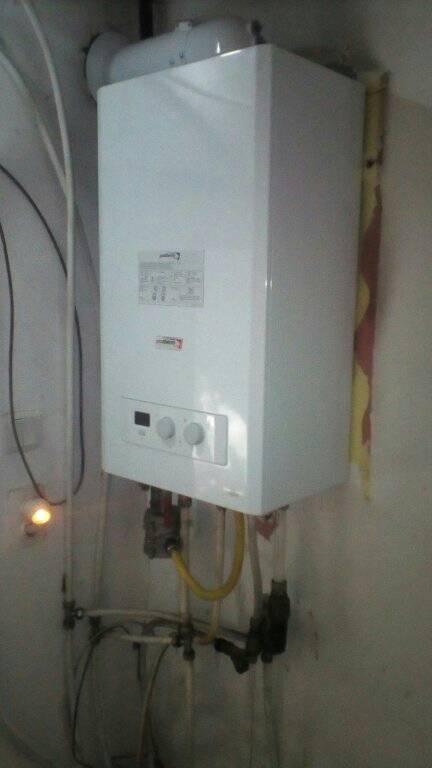
He brought the unit I ordered, a Protherm Lynx Condens 25-A, made in Germany. Very nice, if I do say so myself. Its retail price is around 700USD, so the rest of the money (~800USD) that I'll be paying is labor, profit and a significant chunk probably goes to the bank. Overall it's not a bad deal.

So the young guy installed it with no major issues ... he did an OK job, while discussing business, politics and life...etc. It took him about 3 hours to massage everything into place, as the space was really tight and the pipes had slightly different layout than the old unit.


Yeah, I know, I really need to repaint the walls and clean the pipes ... but for now it works, and I love it!

My old unit had a 89% efficiency rating, meaning that some of the gas and generated heat escaped through the ventilation ... but still very good for the year 2007, when I bought it.

The new unit however has a 108% efficiency rating, which mathematicians will tell you is impossible, but they use some sort of technology that captures condensation from the escaping hot air and extracts additional heat from it. Then some (acidic) water pours out of the unit (into the kitchen sink, through the wall).

What they warned me about is grounding, which my house doesn't really have, due to inappropriate soil in this neighborhood. I told the safety inspector that it's not possible to do it and the gas pipe provides plenty of grounding (as measured by a qualified electrician) ... but yeah, I'll need to buy a lot of copper rods (about 3x more than normal) and start planting them in the garden alongside the house ... and hopefully in the end I'll have proper grounding. Otherwise they won't fix the mainboard of the unit, if it fails under warranty... and that part could cost even more, about 300USD new...

Hello World Update

I've been neglecting this blog for a while now, as I focused on Youtube videos, Facebook Videoslive streaming and local affiliate marketing. However, recently a certain international retailer changed its rules and allows affiliates to get their money faster, directly into their bank accounts, even in Europe, where I live.


This unexpected news makes me focus more of my time on blog posts, with an acceptable amount of embedded affiliate links of course, so hopefully I'll earn a couple hundred dollars per month from this blog ... that's all I need to keep doing videos and blog posts, I'm not greedy...

More useful posts will follow, have a great day!


Apple and Tesla vs. right to repair

The Right To Repair is a legal concept thrown around a lot in the past few years, which would force manufacturers to allow third party repair shops to service their products (tractors, cars, laptops, phones...etc.) and to sell spare parts at a reasonable price.


Some legislation has been passed in 16 states of the USA, but most of them are incomplete and still let manufacturers off the hook, when they don't provide parts and repair manuals.

Apple makes all kinds of IT products, but most of its profit comes from the iPhones, consisting of a generous margin on the hardware product, services and a considerable margin on the Apple App Store... long story short, Apple is an extremely profitable company and it's buying back its shares, paying dividends ...etc... absolutely no losses in the recent years.

Add to these purely financial reasons the fact that iPhones are built using standard electronics components, just like any other smartphones, there is no real world obstacle for Apple to provide parts for everyone... they just don't want to. A positive example is Samsung, as they have a reasonably priced parts store, where anyone can order parts on-line for almost any Samsung product, nice and easy....

http://www.samsungparts.com/Default.aspx
There are several lawsuits and lobbying going on right now, so hopefully somebody will force Apple to take care of its customers properly, instead of frequent warranty refusals and 2-3 week wait times.

Tesla makes electric cars, solar panels and stationary energy storage products, with advanced electronics (most of them unique) inside. Almost none of their parts are standard.

Tesla is also in startup mode, financially speaking, as they are still ramping up production. It seems the Model S and X production has stabilized at about 100.000 units per year, but they have about 600.000 preorders for the Model 3, out of which they delivered about 70-100K units... they currently make ~5000units/week, but they have to reach 10K/week by the end of the year.


They have at least 4 new exciting products to manufacture, Tesla Semi, Pickup, Model Y and Roadster, which will require some more serious investment ... long story short, until 2018Q3 they've been investing everything they could ... but they promised they'll be profitable by the end of the year.

So comparing Tesla to Apple, especially in financial terms (with Apples' estimated 300 billion dollars in cash) makes no sense at all. Apple is a mature company sitting on a huge cash pile and no upcoming revolutionary products, so they should definitely be forced to provide parts for their products, which fail quite frequently.


Tesla needs more time. In my opinion Tesla should be forced to provide most parts for the Model S and X, with certain exceptions of course, which can't be replaced by just anybody off the street (ex: battery pack, falcon wing doors, cameras and sensors...etc.). BUT for the Model 3 and upcoming Semi, Pickup, Model Y and Roadster they should be allowed to "do the best they can", as every manufactured part needs to go into new products, to do right by all the people on the list who preordered. When the preordered list gets shorter, 1-2 years after start of production, then they should in fact provide service manuals and (most) parts for any Tesla owner and repair shop.